

Professor Tiantian Yang’s Research Group
School for Environment and Sustainability
University of Michigan–Ann Arbor, USA
Hydrometeorology • Water Resources • Climate Extremes
Artificial Intelligence • Data Science and Machine Learning
Available Positions
Professor Tiantian Yang’s research group invites applications for one fully funded PhD position and one postdoctoral position, covering tuition, insurance, and salary. We welcome applicants with backgrounds or research interests in hydrology, water resources management, data science, artificial intelligence and deep learning, extreme weather, climate change, and civil or water resources engineering.
PhD position: Fall 2027 start. Interviews are planned for October–November 2026. The university application deadline is December 1, 2026.
Postdoctoral position: Expected start in early to mid-2027, with a later start date negotiable depending on individual circumstances.
Prospective applicants may contact Professor Yang now to arrange an initial discussion. Recruitment will continue until the positions are filled.
Applicant Qualifications
Basic Requirements
- PhD applicants must meet the admission requirements of the University of Michigan’s Rackham Graduate School (including English proficiency requirements).
- A relevant background in hydrology, water resources, atmospheric science, AI or deep learning, data science, civil or environmental engineering, hydraulic engineering, geographic information science, the water–energy–food nexus, or a related field.
- A rigorous approach to research, initiative, creativity, and the ability to work effectively in a collaborative research environment with MS students, PhD students, and other Postdocs.
Preferred Experience (not mandatory)
Experience in one or more of the following areas is an advantage. Applicants without this experience are also encouraged to apply and can develop these skills during their research training.
- Numerical modeling: Experience running hydrologic or land-surface models such as SAC-SMA, VIC, SWAT, WRF-Hydro, or Noah-MP; developing or applying AI and deep learning models such as LSTMs or diffusion models; or working with atmospheric and climate models such as WRF, MPAS, CESM, or E3SM.
- Mathematical and statistical analysis: Basic machine learning experience, including scikit-learn, PyTorch, Keras, image processing, or deep learning with PyTorch.
- Software and visualization: Experience developing graphical user interfaces, analyzing and visualizing geospatial data, or building interfaces to visualize the outputs of backend AI models.
How to Apply
Please email Professor Yang at yangtt@umich.edu or WeChat: tiantiay, with the following materials:
For PhD applicants:
- Your recent curriculum vitae or CV.
- Your undergraduate transcript.
- TOEFL or IELTS scores. PhD applicants must provide valid scores.
- GRE scores, if available.
- A brief statement of research interests (in email).
For Postdoc applicants:
- Your recent curriculum vitae or CV.
- 1-2 of your signature publications in pdf.
- A brief statement of research interests (in email).
When sending a contact request, include your full name, undergraduate institution, and whether you are applying for the PhD or postdoctoral position.
About University of Michigan at Ann Arbor
The University of Michigan–Ann Arbor is a Carnegie R1 research university and is widely recognized as one of the leading public universities in the United States. Often described as a “Public Ivy,” it is known for strong programs across engineering, environment and sustainability, medicine, and the social sciences. SEAS has an international reputation for research on climate change, freshwater resources, and sustainability.
Living and Working in Ann Arbor
The university is located in Ann Arbor, Michigan, approximately a 40-minute drive from Detroit. Ann Arbor is a college town with convenient amenities, a strong cultural life, and active arts, music, and sports communities. Asian grocery stores and restaurants are readily available. The city has frequently appeared in national rankings of desirable places to live and college towns.
Nearby Detroit is home to teams in all four major U.S. professional sports leagues, including the NBA’s Detroit Pistons, who play at Little Caesars Arena. Known as the Motor City, the Detroit metropolitan area is a major center for the automotive industry, including Ford, General Motors, and Chrysler.
Michigan’s location in the Great Lakes region, with access to Canada and abundant freshwater resources, provides a setting for water and environmental research. The Ann Arbor and Detroit region also has a growing technology sector, with employers such as KLA, Google, and Woven by Toyota. Investment in AI and data infrastructure includes an OpenAI, Oracle, and Related Digital data center project in Saline Township near Ann Arbor. These activities broaden the region’s research and career opportunities.
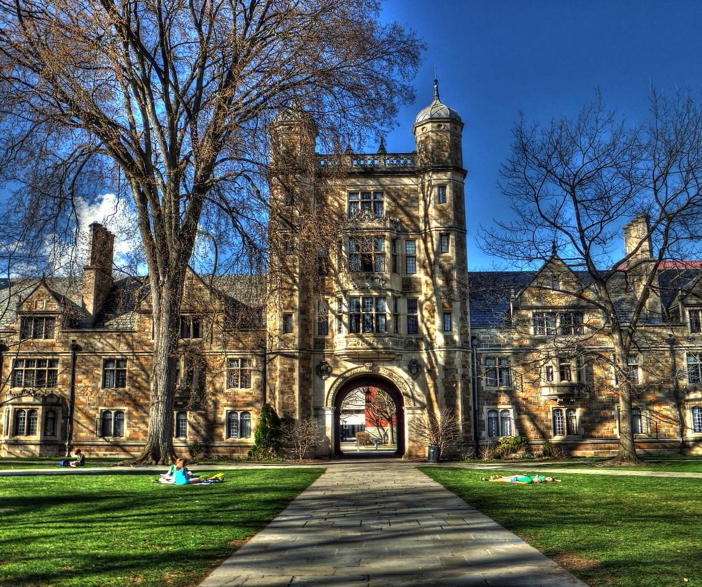
University of Michigan–Ann Arbor campus